
You’ve washed your face, applied your moisturiser and gone about your morning. Everything feels fine. Your skin is soft, comfortable and nicely moisturised.
Then, somewhere between your first cup of coffee and lunchtime, that familiar tightness returns.
Maybe it’s your cheeks. Maybe it’s the area around your mouth. Or perhaps your skin simply feels dry again, even though you were generous with your moisturiser.
If you’ve got a travel friendly moisturiser tucked into your bag, you apply another layer. After all, nobody’s carrying a two litre bottle around! And if you don’t have one handy, you simply put up with the dryness until you’re home.
But here’s the interesting part – dry skin isn’t always a sign that you’re using too little moisturiser. Sometimes, it’s about how your skin holds on to moisture in the first place.
From the way you wash your face to the ingredients in your skincare and even the air around you, several things can influence how your skin feels throughout the day.
Let’s look at seven reasons your skin might still feel dry after moisturising and what you can do about them.
1. Your Skin Is Losing Moisture Faster Than It Can Hold On to It
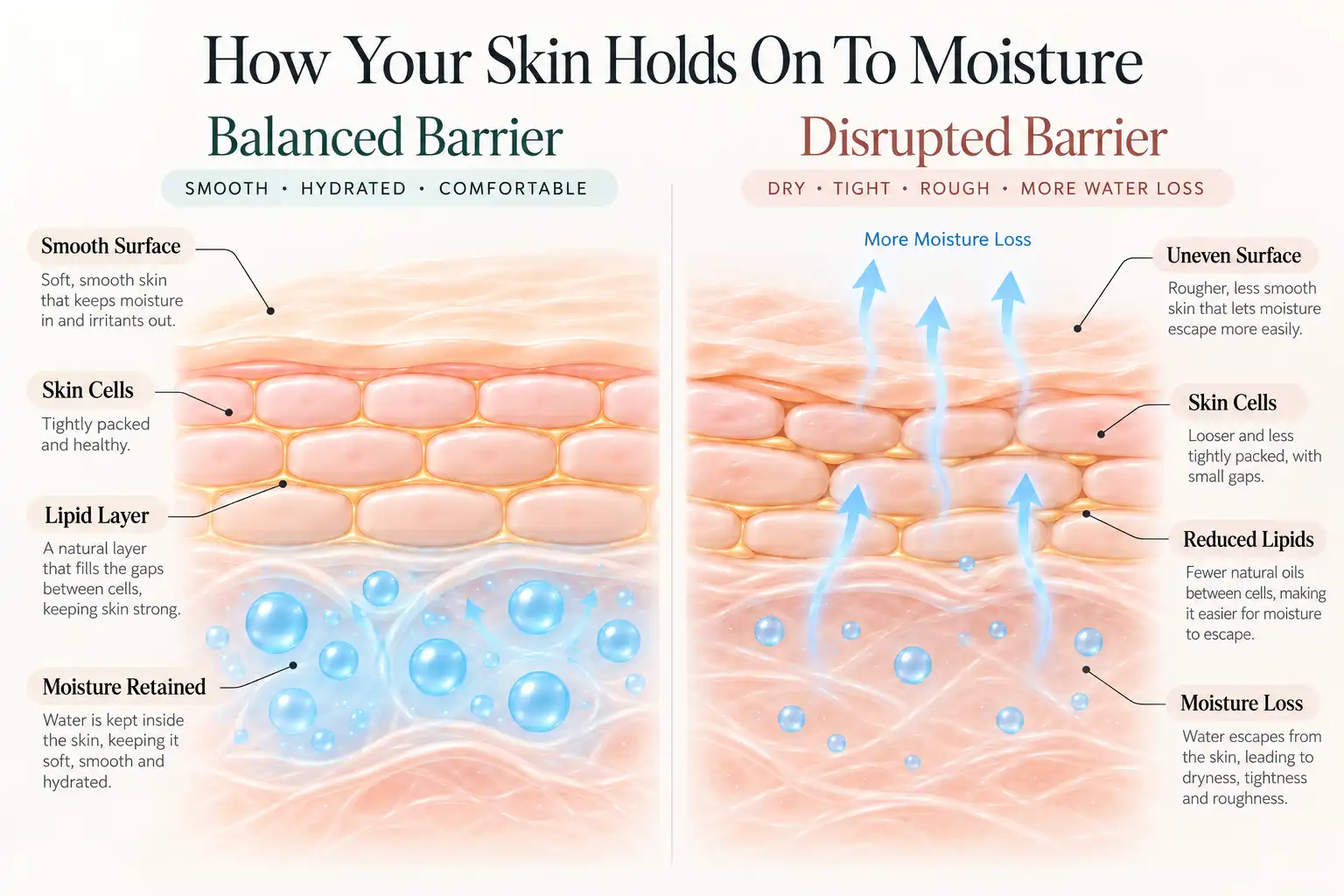
Your skin has a protective outer layer called the skin barrier. Among its many jobs, it helps keep water from escaping too quickly. When this structure is functioning properly, your skin is better equipped to retain moisture. When it’s disrupted, water can escape more readily.
This is known as transepidermal water loss (TEWL).
You might notice tightness, roughness or flaky patches, even though you’ve been moisturising regularly.
What Can You Do?
Look beyond the immediate feeling of softness a moisturiser gives you.
Ingredients such as ceramides, niacinamide and panthenol are worth understanding because they can contribute to moisture retention and skin barrier care.
Ceramides are naturally found in the skin and help maintain its protective structure. Niacinamide supports skin conditioning and barrier function, while panthenol helps with hydration and skin comfort.
The formulation matters, of course. But understanding these ingredients can make choosing a moisturiser a little less confusing.
2. You’re Waiting Too Long After Washing Your Face
Think about your usual morning. You wash your face, dry it, brush your hair, get dressed and eventually remember to apply your moisturiser. It’s a perfectly ordinary routine.
But there’s a small change worth trying.
Applying moisturiser while your skin is still slightly damp after washing or bathing helps retain some of the moisture on its surface. When you wait until your skin is completely dry, you miss that opportunity.
A Small Change Worth Making
After cleansing, gently pat your skin with a soft towel, leaving it slightly damp. Then apply your moisturiser.
The same principle applies to body care. Moisturising shortly after a shower can be especially helpful for areas such as the arms, legs and elbows. It doesn’t require another product or an elaborate routine. Just a small change in timing.
3. Your Face Wash Could Be Part of the Problem
There’s something satisfying about a freshly washed face.
But there’s a difference between skin that feels clean and skin that feels stripped.
If your face becomes tight almost immediately after cleansing, your washing routine deserves a closer look.
Some cleansers can remove too much of the skin’s natural oils, particularly when used frequently or alongside hot water. If cleansing is leaving your skin excessively dry, applying moisturiser afterwards may not be enough to keep it comfortable for long.

How Should Your Skin Feel After Cleansing?
Fresh and clean, without uncomfortable tightness. A gentle cleanser should remove everyday dirt, oil and residue without unnecessarily disrupting the skin’s natural moisture balance.
Try using lukewarm water rather than hot water and avoid washing your face more often than necessary. You may also want to reconsider frequent facial scrubbing, particularly if your skin already feels rough or dry.
A Creamy Cleanse Can Make a Difference to How Skin Feels
The texture and formulation of your face wash deserve just as much attention as the moisturiser you apply afterwards.
SNAYRAH’s Dermatologically Tested Face Wash with Ceramide & Vitamin E has a creamy, lightweight consistency that works into a gentle lather, helping remove everyday impurities while leaving skin feeling fresh, soft & moisturised without an uncomfortable tight after feel.
Its formulation brings together Hyaluronic Acid, Ceramide NP, Jojoba Seed Oil, Sodium PCA, Vitamin E & Chamomile Extract. The face wash is dermatologically tested, paraben & sulphate free and created for everyday facial cleansing.
It’s a reminder that a comfortable moisturising routine begins long before you reach for your moisturiser.
4. Your Moisturiser May Not Be the Right Texture for Your Skin
Not all moisturisers work in quite the same way. Some feel light and milky, spreading almost effortlessly before settling into the skin. Others are rich, creamy and leave a more noticeable protective layer behind.
Neither texture is automatically better.
A lightweight moisturiser may feel more comfortable in humid conditions or when you want something that sits easily under sunscreen. A richer cream or ointment may provide more moisture retention when your skin is particularly dry.
What makes the difference isn’t simply how thick a product feels, but its complete formulation.
Hydration & Moisture Retention Aren’t Quite the Same Thing
Moisturisers often contain a combination of three types of ingredients.
- Humectants help attract and retain water. Glycerin and hyaluronic acid are familiar examples.
- Emollients help soften and smooth the skin.
- Occlusives help reduce the amount of water escaping from its surface.
A moisturiser can combine these functions, although different formulations may suit different needs.
Don’t judge a moisturiser only by whether it feels heavy or lightweight. Notice how your skin responds after you’ve been wearing it for a few hours.
5. Your Skin Might Be Dehydrated Rather Than Naturally Dry
Here’s where skincare language becomes a little confusing.
We often use the words dry and dehydrated as though they mean exactly the same thing.
They don’t.
Dry skin generally describes a skin type or condition associated with insufficient natural oils and difficulty maintaining moisture. Dehydration, meanwhile, refers to a lack of water in the skin. It’s possible for skin that produces plenty of oil to feel dehydrated too.
That explains why someone may have an oily looking forehead yet still experience uncomfortable tightness.
What Should You Look Out For?
Dry skin may feel rough, flaky or uncomfortable on a regular basis.
Dehydrated skin may temporarily feel tight or appear less supple.
However, these signs often overlap. Appearance alone isn’t enough to determine exactly what’s happening. Instead of immediately buying another serum, consider the bigger picture.
Are you cleansing too frequently? Spending long hours in dry indoor air? Using a moisturiser that doesn’t provide enough moisture retention?
Sometimes, the answer lies in adjusting your existing routine.
6. Your Surroundings May Be Drying Out Your Skin
Have you noticed how your skin can feel comfortable at home but noticeably drier after a day in an air-conditioned office?
It’s not necessarily your imagination. Air conditioning can reduce indoor humidity and dry air can contribute to moisture loss from the skin.
The effect may become more noticeable during cooler months, in low-humidity environments or when you’re moving between different temperatures throughout the day. Even your bathing habits play a role.
Long, hot showers might feel relaxing, but they can leave your skin feeling drier afterwards.
How Can You Make Your Environment More Skin-Friendly?
Start with a few manageable habits. Keep showers comfortably warm rather than hot. Apply moisturiser shortly after bathing and pay attention to the areas of your body that tend to become dry first.
If your indoor environment is consistently dry, a properly maintained humidifier may be helpful.
There’s no need to control every environmental factor. Simply recognising what makes your skin feel uncomfortable can help you care for it more consistently.
7. You Could Be Doing Too Much to Your Skin
Skincare has become wonderfully varied.
There are exfoliating acids, retinoids, brightening serums, cleansing masks and more active ingredients than most of us can remember. But using several products doesn’t automatically mean your skin is receiving better care.
Exfoliating too often or combining products that irritate your skin can leave it feeling dry, tight or uncomfortable and when that happens, applying more moisturiser may not solve the underlying issue.
Could a Simpler Routine Help?
Sometimes, yes.
A gentle cleanser, a suitable moisturiser and daily sun protection can provide a straightforward foundation.
From there, additional products can be introduced according to your skin’s needs rather than simply because they’re popular.
If you’re looking to simplify your daily skincare habits, our 4-Step Minimalist Skincare Routine offers another perspective on keeping everyday care manageable. If you’re dealing with stinging, persistent redness or visible irritation, consider whether any recently introduced products could be contributing.
And if symptoms continue, a dermatologist can help identify what’s causing them.
Your skincare routine should work with your skin, not constantly challenge it.
What Ingredients Should You Look for When Your Skin Feels Dry?
Once you understand the possible causes of dryness, choosing skincare becomes less about collecting products and more about knowing what you’re looking for. You don’t need to memorise every ingredient on a label. But a few are worth recognising.
- Ceramides – Helping Skin Hold On to Moisture
Ceramides are naturally occurring lipids that form part of the skin’s protective barrier. They help maintain the structure that limits excessive moisture loss. When included in a suitable moisturising formula, ceramides can contribute to skin barrier support and moisture retention.
- Niacinamide – Supporting Skin Barrier Function
Niacinamide, a form of Vitamin B3, is a versatile skincare ingredient. Research has shown that topical niacinamide can influence the production of certain skin lipids, including ceramides. This makes it an interesting ingredient in formulations designed around skin conditioning and barrier care.
- Panthenol – Helping Skin Feel Soft & Comfortable
Panthenol, also called Pro-Vitamin B5, is commonly used for its moisturising and skin-conditioning properties. It helps retain hydration and can contribute to a softer, more comfortable skin feel.
Aloe Vera – Lightweight, Refreshing Hydration
Aloe Vera is especially familiar to anyone who enjoys a fresh, cooling skincare texture. It’s widely used in gels and moisturising formulas, where it contributes to hydration and a pleasant skin feel. If you’d like to explore its uses in more detail, read our Aloe Vera Gel for Skin: Benefits, History & Routine.
Of course, no single ingredient tells the whole story.
A product’s overall formulation, how it feels on your skin and whether it suits your particular needs matter just as much as the ingredients highlighted on its packaging.
A Little Thought Behind Everyday Moisturisation
At SNAYRAH, we believe moisturising should feel like a natural part of your day rather than another complicated skincare step.
Our Niacinamide & Ceramide Face & Body Moisturiser brings together Niacinamide, Ceramide NP, Panthenol, Centella Asiatica Extract, Aloe Vera, Vitamin E & Allantoin in a milky, lightweight formula.
The texture spreads easily and leaves skin feeling soft and moisturised without a heavy after-feel. Created for everyday face & body care, it is formulated without added fragrance or colour and is paraben & sulphate free. The compact 100ml bottle is also travel-friendly, making it convenient to carry for moisturisation whenever needed.
It’s a simple approach to everyday skincare: thoughtfully selected ingredients, a comfortable texture and a routine that’s easy to maintain.
A Final Thought: Moisturising Is About More Than the Moisturiser
It’s easy to think that dry skin simply needs more cream. But sometimes, your skin is asking for something different. A gentler cleanser. A change in how you moisturise. A little more attention to your surroundings. Or a formula that better suits your skin’s needs.
None of these changes has to be complicated.
A good skincare routine isn’t necessarily the one with the most products. It’s the one that helps your skin feel comfortable, day after day. Before adding another layer of moisturiser, take a moment to understand why your skin might be feeling dry in the first place.
That small shift in understanding could make a meaningful difference to how you care for it.
Scientific References
British Journal of Dermatology — Nicotinamide & Skin Barrier Lipids (Research Abstract)
American Academy of Dermatology — Dermatologists’ Top Tips for Relieving Dry Skin
American Academy of Dermatology — How to Pick the Right Moisturiser for Your Skin